
Parking rows & drive aisles
Consider the routes drivers use, spaces between parked vehicles, and the transitions between rows. A bright pool beneath each pole can still leave uneven coverage between fixtures.
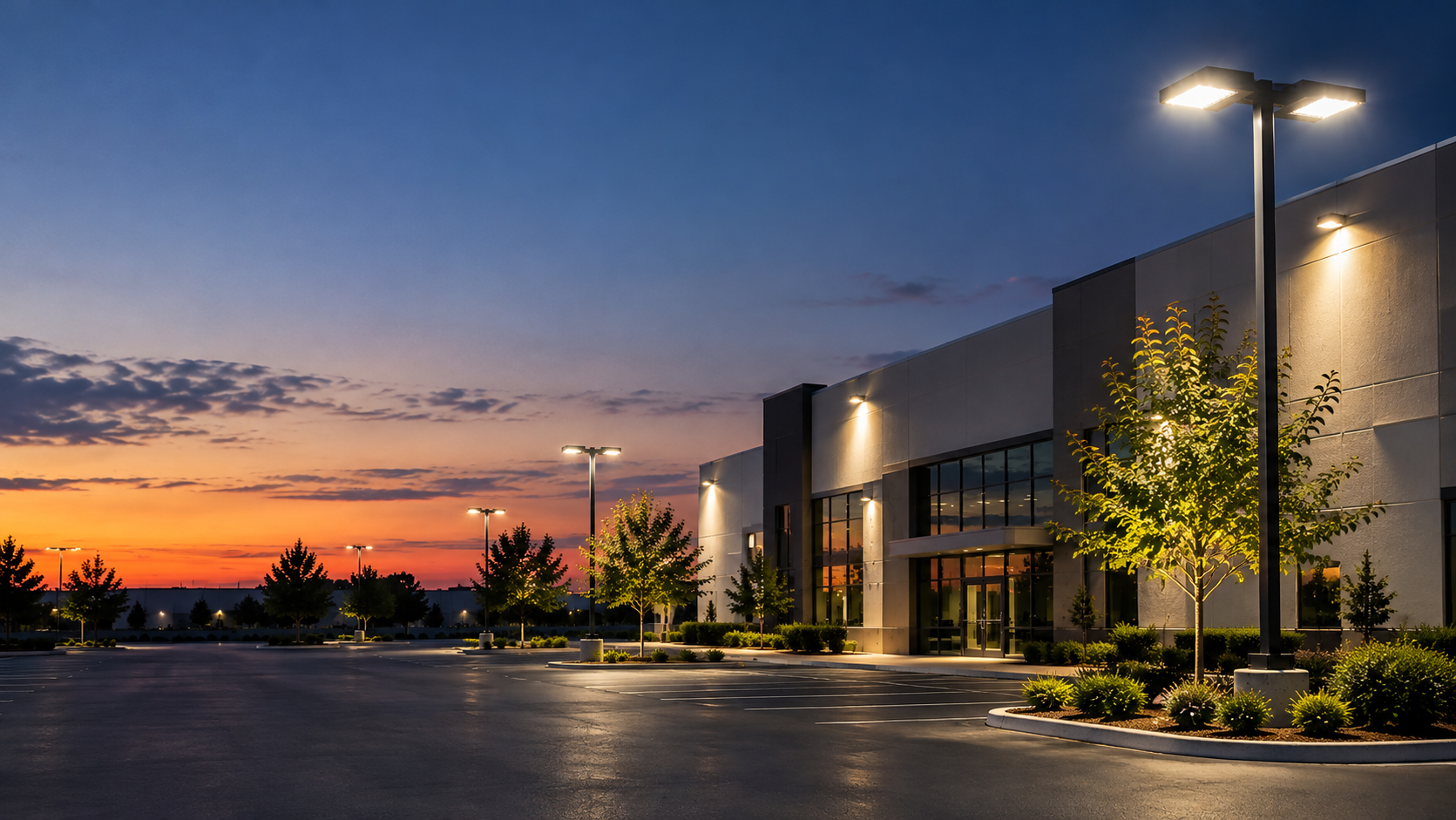
Plan lighting around vehicle routes, pedestrian paths, and entrances, not just beneath each pole. Edge LED Lighting helps Indianapolis property managers assess older fixtures, plan LED area-light coverage, and coordinate installation.
Our in-house installation team works at commercial sites, with additional project resources used when needed.
Look at the whole property
Retail centers, office properties, and industrial sites have different nighttime patterns. Tenant hours, delivery activity, landscaping, and the location of entrances help determine where light is useful. We review these details before selecting fixtures or assuming the existing pole layout is the right one.
Consider the routes drivers use, spaces between parked vehicles, and the transitions between rows. A bright pool beneath each pole can still leave uneven coverage between fixtures.
Review the paths from parking spaces to building doors, accessible routes, crossings, and curb changes. Pole lighting and building-mounted fixtures should be considered together, not as isolated systems.
Pay attention to boundaries, nearby homes, public roads, and adjacent businesses. Fixture distribution and shielding can help direct light toward the lot rather than beyond it.
Pole-mounted LED area lights are available with different optics and mounting arrangements. A fixture near the lot edge may need a different distribution from one between parking rows. Pole height, spacing, arm position, and whether a pole carries one or several fixtures all influence the selection.
We consider useful light output, color temperature, outdoor suitability, mounting compatibility, and shielding, not wattage alone. Existing wall-mounted lights near entrances may also need to be included in the layout.
Explore commercial LED fixture optionsLighting a fueling site? Pump canopies need a different mounting and coverage approach from general pole lighting. Explore gas station canopy and forecourt lighting.
Assess before replacing
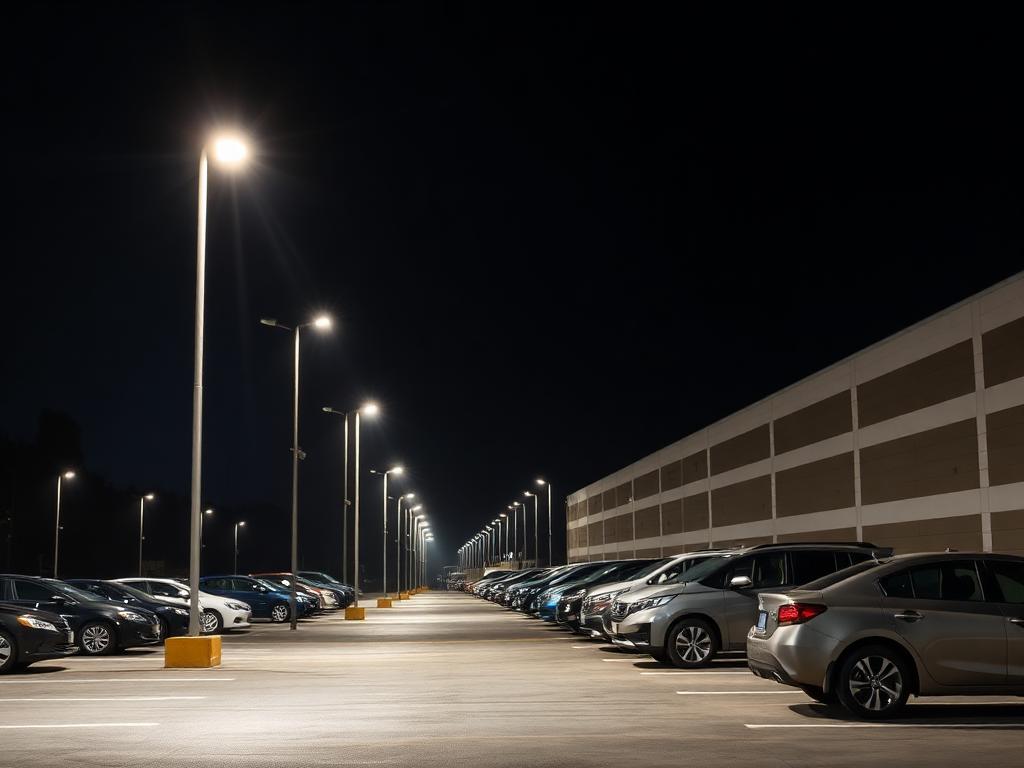
Aging metal-halide or high-pressure sodium equipment may be a candidate for a compatible LED retrofit or complete fixture replacement. Housing condition, ballast and wiring arrangements, heat management, and the proposed light distribution help determine which approach makes sense.
A new fixture does not resolve every issue beneath it. Existing poles, bases, electrical conditions, and access must be considered separately. Pole relocation, new foundations, or changes to electrical infrastructure need a defined scope and any additional evaluation appropriate to the work.
For parking lot lighting design in Indianapolis, a photometric layout can help compare fixture placement and expected illuminance before installation. Manufacturer IES files describe fixture distribution; a site model applies that data to proposed pole heights, locations, and calculation areas.
Average light levels can conceal darker patches. Minimum levels and average-to-minimum or maximum-to-minimum ratios help evaluate uniformity across the lot. The appropriate targets depend on property use and applicable requirements, rather than one universal foot-candle value.
Modeled results are planning estimates. Actual mounting, obstructions, surface conditions, and equipment performance can affect measured light levels.
Learn about photometric & IES planningMore output is not always better. Bright light sources in a driver's or pedestrian's view can create discomfort. Optical selection, fixture orientation, mounting height, and suitable shielding help balance coverage with glare and light reaching neighboring windows or roads.
Photocells, time schedules, or compatible dimming may suit the property's operating pattern. We review existing controls and fixture compatibility, including whether different zones need different schedules. Local outdoor-lighting requirements and site restrictions should be checked during planning; compliance is not assumed from a fixture label alone.
Plan access as carefully as coverage
Share the site address, existing fixtures, pole locations, and nighttime concerns. A site plan or photos can help identify what needs a closer look.
Evaluate compatible LED options, mounting arrangements, and distribution. Use a photometric layout where appropriate to compare expected coverage.
Review fixture quantities, access, electrical conditions, any pole-related work, and scheduling before agreeing on a proposal.
Our in-house installation team coordinates with your property contact around agreed access and work zones. Additional project resources may be used when needed.
We serve Indianapolis and Central Indiana, including Greenwood, Carmel, Fishers, Plainfield, and nearby communities, and consider qualifying commercial projects nationwide subject to scope, logistics and applicable local requirements. Share your property address so we can discuss the parking-lot installation you have in mind.
View our service areasPlanning an indoor upgrade too? Explore warehouse LED lighting installation.
Practical answers for property managers
Possibly. Pole condition, mounting adapters, fixture weight and wind-loading suitability, wiring, and the proposed light distribution need review. Existing pole locations may work for a replacement layout, but keeping every pole does not automatically provide suitable coverage. Structural concerns or proposed pole changes may require additional evaluation.
The decision depends on housing condition, electrical and thermal compatibility, mounting, and the performance of the proposed LED option. A compatible retrofit may be considered; replacing the complete fixture may offer a more suitable optical distribution or resolve condition issues. We assess the existing equipment rather than recommending a lamp swap for every fixture.
A layout uses fixture IES data and site geometry to estimate illuminance, often expressed in foot-candles, across a calculation grid. It can help compare average and minimum light levels, uniformity, spacing, and property-line spill. Mounting height, obstructions, and the model's assumptions matter. Predicted results guide design; they are not a guarantee of measured field performance.
Square footage or wattage alone is not enough to determine fixture count. Pole positions and heights, parking geometry, pedestrian routes, fixture distribution, and the intended light levels all affect the layout. Share your current pole and fixture counts so we can review the options before proposing a quantity.
Not necessarily. Raising output may increase glare and light beneath the poles without adequately lighting the gaps. A different distribution, mounting arrangement, or fixture location may be more useful. We consider minimum light levels and uniformity alongside overall brightness.
We consider fixture orientation, optical distribution, mounting height, shielding options, and property boundaries. Selected fixtures and shields must be suitable for the installation. Local requirements and any property-specific restrictions need to be reviewed as part of planning; no fixture choice automatically guarantees compliance or eliminates all glare.
We discuss operating hours, parking demand, lift access, work zones, and any areas that must be temporarily closed with your property contact. Phasing may be possible depending on the scope. Electrical interruptions, weather, and site conditions can affect scheduling, so we do not promise disruption-free installation.
Fixture selection and count, pole height, mounting adapters, lift access, existing electrical conditions, and any pole or foundation work affect the scope. Start with the property address, current lighting concerns, and any fixture details, site plans, or operating-hour restrictions you have. Requesting a quote is free and comes with no obligation.
Start with your property
Tell us your property location, what is not working with the lighting, and which areas need attention. Include pole heights, fixture counts, tenant hours, or layout details in your message if available.
You do not need a finished lighting plan to begin. We can discuss the site information needed to develop suitable fixture and installation options. Quote requests are free and carry no obligation.
(317) 548-5355